Compensation guide for bulk cargo transportation damage: How to minimize logistics risk losses
In international trade, damage to goods is not a “probability” issue, but a “normal” risk that must be faced in supply chain management.

In international trade, damage to goods is not a “probability” issue, but a “normal” risk that must be faced in supply chain management. When an importer discovers that a full container of bulk goods or bulk cargo (LCL) has been damaged during unpacking, the immediate handling method directly determines the success or failure of the claim. The core handling principles are: keep the scene as it is, take photos to collect evidence, and sign for exceptions on the waybill (POD). Receipt without written objection will be deemed as the goods have been delivered intact, and the difficulty of later recovery will increase exponentially.
Chapter 1: Emergency response process after discovery of damaged goods
For bulk goods worth tens of thousands of dollars, standard SOPs (standard operating procedures) are the cornerstone for recovering losses.
1. Stop unloading immediately and keep evidence
Once the packaging is damaged, water-stained, tilted or deformed during container opening or pallet handling, the operation must be stopped immediately.
Comprehensive photography/video recording: Take photos of the container seal number, the appearance of the box, the original location of the damaged goods in the box, and the damage details.
Seal inspection: Confirm whether the container seal is intact. If the seal is cut or replaced, it may involve illegal unpacking during transit or improper customs inspection. Here is Ningbo to United States LCL DDP Shipping 2026: AEO Certification Guide.
2. Execute “Noting Exceptions”
When signing the Proof of Delivery (POD), you must not just sign your name. It must be clearly marked at the signature: “Subject to further inspection, cargo damaged” or a specific description of the damage. If the carrier refuses to let you make a note, please reject the damaged part directly and videotape it as evidence.
3. Issue a formal Notice of Claim
A formal written notice must be sent to the shipping company, air carrier and freight forwarder within the time limit specified by law (usually within 3 days after unloading, depending on the specific shipping convention), stating that the right to recover is reserved.
Chapter 2: Key Documents: A Necessary Checklist for Claims
Bulk cargo claims are a game of law and writing, and the integrity of the evidence chain is crucial. You need to prepare the following documents:
Commercial Invoice: Proves the actual value of the goods.
Packing List: Confirm the specifications, quantity and weight of the damaged goods.
Bill of Lading: The legal basis of the transportation contract. It needs to be confirmed whether it is a “Clean B/L”.

Cargo damage photos and claims report: Detailed record of the type of damage (such as physical impact, chemical leakage, moisture damage, etc.).
Notary inspection report (Survey Report): For bulk goods, it is recommended to hire a third-party independent notary (such as SGS, etc.) to conduct on-site inspections. Their reports are highly effective in international arbitration.
Chapter 3: Liability Determination: Who Should Pay for Your Loss?
Understanding the legal framework for international freight can help you accurately locate the claimants.
1. Limitation of liability of shipping company (carrier)
According to the Hague Rules or Visby Rules, shipping companies’ compensation for cargo damage usually has a maximum limit of “per piece” or “per kilogram”. This means that if full insurance is not purchased, even if it is proven that the shipping company is responsible, the compensation you receive may be far less than the actual value of the goods.
2. Improper packaging: the factory’s responsibility
If the notary determines that the cargo damage is caused by insufficient reinforcement (Lashing) in the container or insufficient packaging strength, then the claimant should be directed to the shipping factory (Supplier). In bulk trade, this usually involves the division of responsibilities under FOB or CIF terms.
3. Insurance companies: the fastest way to stop losses
If you purchased “All Risks”, the most efficient way is to file a claim directly with the insurance company. The insurance company will subrogate the claim and pay you in advance, which can significantly relieve the company’s cash flow pressure.
Chapter 4: Pitfall Avoidance Guide: How to Prevent Bulk Freight Damage?
Rather than getting caught up in a lengthy claims tug-of-war after the fact, it’s better to build defenses before shipment.
Strengthen loading supervision: require factories to provide photos from all angles when packing to ensure that the goods have been legally palletized, reinforced and moisture-proof.
Choose appropriate transportation terms: In large equipment or high-value bulk trade, try to use DDP or DDU terms to hand over complex logistics risks to professional international freight forwarders. Here is Guangzhou to USA DDP Shipping 2026: Complete Guide.
Choose high-quality containers: It is strictly forbidden to use “defective containers” with cracks, holes or odor in the box.
Chapter 5: Professional Risk Management Solutions
When dealing with cross-border logistics of bulk goods, risks lurk in every link of the supply chain. Medium and large-sized trade goods shipped from major ports in China require more professional implementation and full-process supervision.
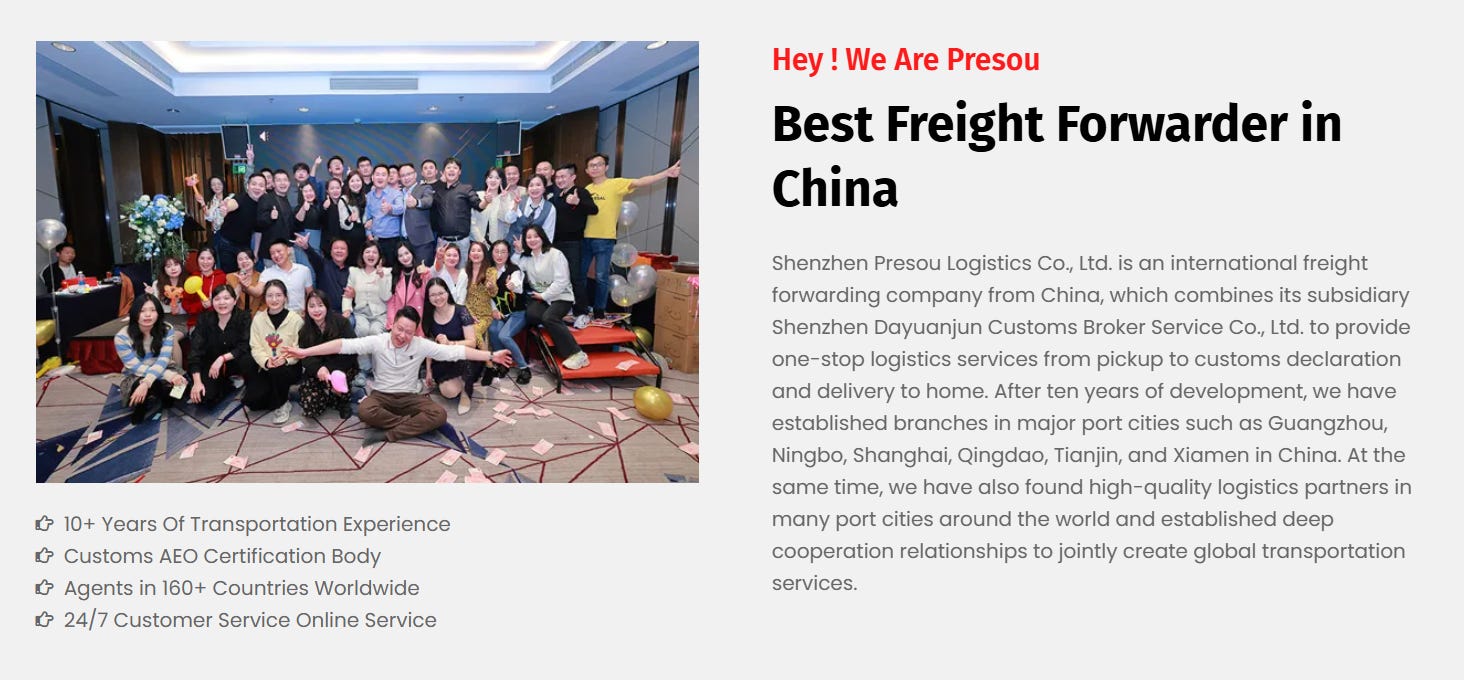
As a well-known brand deeply involved in the field of international freight forwarding, Presou is well aware of the complexity of bulk cargo transportation. Our wholly-owned subsidiary Shenzhen Dayuanjun is responsible for the implementation of all business, providing one-stop services from factory pickup, professional customs declaration to home delivery at the destination.
With 10 years of industry accumulation, Presou has branches in China’s core port cities - Guangzhou, Ningbo, Shanghai, Qingdao, Tianjin and Xiamen, ensuring that it can respond to customers’ offline loading needs as soon as possible.
Our core strengths:
Global Deep Network: Good at handling DDP/DDU door-to-door services, and unified coverage of originally fragmented claims risks.
Focus on bulk cargo: We focus on the cross-border flow of medium and large cargo and do not undertake small package express business. This focus has allowed us to accumulate deep practical experience in heavy cargo reinforcement, special container transportation and bulk trade compliance.
Full chain guarantee: Whether it is early packaging advice or evidence collection assistance after unfortunate cargo damage, we can provide authoritative support based on local experience.
In the game of bulk trade, choosing a partner who understands the law, understands operations, and has actual control over major ports is the key for importers to avoid the risk of bad debts.